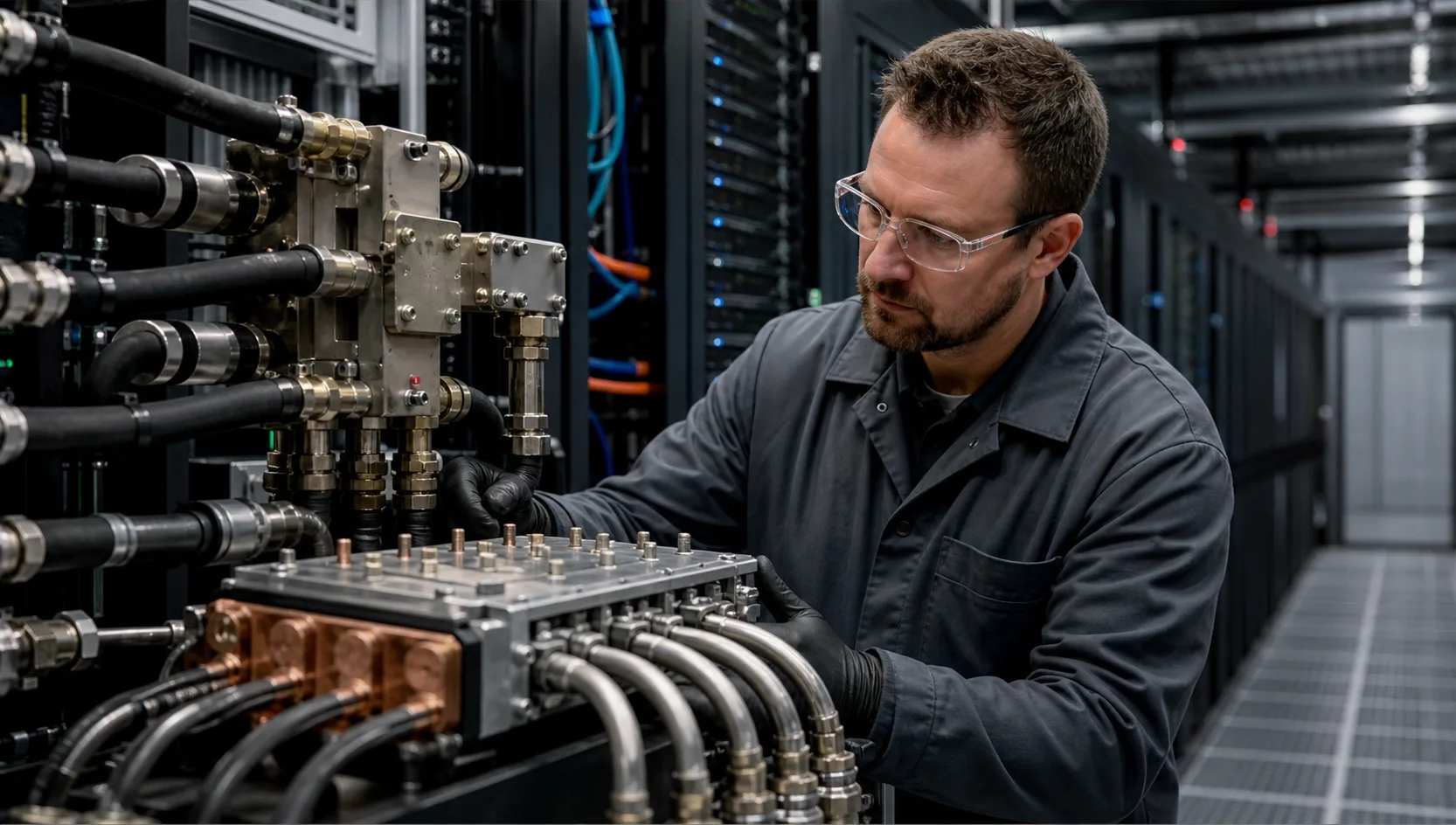
Liquid cooling is no longer a question of whether, but of when — and for most operators, the honest answer is sooner than the current rack profile suggests. Accelerator densities have crossed the threshold where air alone cannot economically remove heat, and the next refresh cycle frequently brings hardware that assumes direct-to-chip cooling out of the box. Designing for that future today is far less expensive than retrofitting a live hall later.
Readiness does not mean cooling every rack with liquid on day one. It means making the structural, mechanical, and operational decisions now that keep the liquid path open, so the transition is a planned upgrade rather than a disruptive rebuild.
Engineer the liquid path before you fill it
The expensive parts of liquid cooling are the ones embedded in the building: floor loading for heavier wet racks, space and structure for coolant distribution units, riser and manifold routing, leak detection and containment, and the heat-rejection capacity to actually move that energy outside. A hall that is plumbed and engineered for direct-to-chip — even while it runs air-cooled — can adopt liquid in place. A hall that was not has to be opened up, often while it is carrying production load.
The same logic applies to the facility water system. Sizing primary loops, reserving plant capacity, and pre-positioning connection points for future CDUs are low-cost decisions during design and high-cost ones after commissioning.
A practical readiness framework
We assess readiness across three layers. The first is structural and spatial: can the floor, the risers, and the white space accommodate liquid infrastructure without rework. The second is mechanical: is there reserved heat-rejection and distribution capacity, and are connection points staged. The third is operational: do the monitoring, maintenance, and incident-response procedures exist before the first loop is energized, so the team is not learning liquid cooling during an outage.
For existing facilities, the same framework becomes a phased retrofit plan — identifying which halls can convert in place, which need targeted upgrades, and which are best reserved for air-cooled workloads through their remaining life.
How CloudData.Center helps
Our power and cooling teams engineer liquid readiness into new builds and map pragmatic retrofit paths for existing sites — so direct-to-chip becomes a scheduled upgrade rather than an emergency. We design the loop, the plant, and the operating procedures together.